|
Pain and pain management
Recovery of comfort and function after elbow arthroplasty continues for many months after the surgery.
Elbow replacement arthroplasty is a major surgical procedure that involves cutting of skin, tendons and bone. The pain from this surgery is managed by the anesthetic and by pain medications. Immediately after surgery, strong medications (such as morphine or Demerol) are often given by injection. Within a day or so, oral pain medications (such as hydrocodone or Tylenol with codeine) are usually sufficient.
Pain medications can be very powerful and effective. Their proper use lies in the balancing of their pain relieving effect and their other, less desirable effects. Good pain control is an important part of the postoperative management.
Use of medications
Initially, pain medication is usually administered intravenously or intramuscularly. Sometimes patient controlled analgesia (PCA) is used to allow the patient to administer the medication as needed. Hydrocodone or Tylenol with codeine are taken by mouth. Intravenous pain medications are usually needed only for the first day or two after the procedure. Oral pain medications are usually needed only for the first two weeks after the procedure.
Important side effects
Pain medications can cause drowsiness, slowness of breathing, difficulties in emptying the bladder and bowel, nausea, vomiting and allergic reactions. Patients who have taken substantial narcotic medications in the recent past may find that usual doses of pain medication are less effective. For some patients, balancing the benefits and side effects of pain medication is challenging. Patients should notify their surgeon if they have had previous difficulties with pain medication or pain control. Elbow replacement arthroplasty is a major surgical procedure that involves cutting of skin, tendons and bone. The pain from this surgery is managed by the anesthetic and by pain medications. Immediately after surgery, strong medications (such as morphine or Demerol) are often given by injection. Within a day or so, oral pain medications (such as hydrocodone or Tylenol with codeine) are usually sufficient.
Hospital stay
After surgery the patient spends an hour or so in the recovery room. A drainage tube is usually used to remove excess fluid from the surgical area. The drain is usually removed on the second day after surgery. Bandages cover the incision. They are usually changed the second day after surgery.
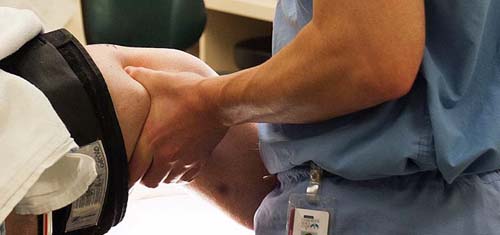
Elbow motion soon after total elbow replacement helps achieve best possible elbow function. During the hospitalization, the patient learns a simple rehabilitation program that will be used for maintaining the range of motion at home after discharge. On the second day after surgery, the physical therapist teaches the patient gentle range of motion exercises. These include flexion (bending), extension (straightening), pronation (palm down) and supination (palm up).
Hospital discharge
Patients are discharged as soon as:
- the incision is dry,
- the elbow is comfortable with oral pain medications,
- the patient can perform the range of motion exercises, and
- the home support systems for the patient are in place.
Discharge is usually on the third or fourth day after surgery.
Convalescent assistance
Walking and use of the arm for gentle activities are encouraged soon after surgery.
For the first month or so after this procedure, the operated arm may be less useful than it was immediately beforehand.
The patient's specific limitations can be specified only by the surgeon who performed the procedure. It is important that the repaired elbow not be challenged until it has had a chance to heal. Usually the patient is asked to lift nothing heavier than a cup of coffee for six weeks after the surgery.
Management of these limitations requires advance planning to accomplish the activities of daily living during the period of recovery.
Patients usually require some assistance with self-care, activities of daily living, shopping and driving for approximately six or so weeks after surgery. Patients usually go home after this surgery, especially if there are people at home who can provide the necessary assistance, or if help can be arranged through an agency. In the absence of home support, a convalescent facility may provide a safe environment for recovery.
Recovery of comfort and function after elbow arthroplasty continues for many months after the surgery. Improvement in some activities may be evident as early as twelve weeks. With persistent effort, patients make progress for as long as a year after surgery.
Physical therapy
After the surgical wound is healed, establishing good elbow motion is a priority.
Elbow motion soon after total elbow replacement helps achieve best possible elbow function. Arthritic elbows are often stiff. One of the major goals of total elbow replacement surgery is to restore motion to the joint. However, after surgery scar tissue will tend to recur and limit movement unless motion is started soon afterwards. This early motion is facilitated by the complete surgical removal of the tight tissues so that after surgery the patient needs to only maintain the range of motion achieved at the operation. Later on, once the elbow is comfortable and flexible, strengthening exercises and additional activities are started.
Rehabilitation options
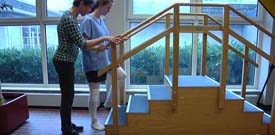
It is often most effective for the patient to carry out their own exercises so that they are done frequently, effectively and comfortably. Usually, a physical therapist or the surgeon instructs the patient in the exercise program and advances it at a rate that is comfortable for the patient. For the first six weeks after surgery, the emphasis is on optimizing the flexibility and range of motion of the elbow through gentle stretching exercises. After six weeks, these stretching exercises are continued and strengthening exercises may be added.
Can rehabilitation be done at home?
In general, the exercises are best performed by the patient at home. Occasional visits to the surgeon or therapist may be useful to check the progress and to review the program.
Usual response
Patients are almost always satisfied with the increases in range of motion, comfort, and function that they achieve with the exercise program. If the exercises are uncomfortable, difficult, or painful, the patient should contact the therapist or surgeon promptly.
Risks
This is a safe rehabilitation program with little risk.
Duration of rehabilitation
Once the range of motion and strength goals are achieved, the exercise program can be cut back to a minimal level. However, gentle stretching is recommended on an ongoing basis.
Returning to ordinary daily activities
In general, patients are able to perform gentle activities of daily living using the operated arm beginning two to six weeks after surgery. Walking is strongly encouraged. Driving should wait until the patient can perform the necessary functions comfortably and confidently. This may take six or more weeks if the surgery has been performed on the right elbow, because of the increased demands on the right elbow in shifting gears.
Long-term patient limitations
Patients should avoid activities that involve impact (hammering, chopping wood, contact sports, sports with major risk of falls) or heavy loads (lifting of heavy weights, heavy resistance exercises). These activities may increase the chance of loosening, wear or fracture.
Costs
The surgeon and therapist should be able to provide information on the usual cost of the rehabilitation program. The program is quite cost effective, because it is based heavily on home exercises.
Summary of elbow replacement surgery for elbow arthritis
Total elbow replacement arthroplasty helps restore comfort and function to elbows damaged by rheumatoid arthritis.
In the hands of an experienced surgeon, elbow joint replacement arthroplasty can be a most effective method for restoring comfort and function to elbows with joint surfaces damaged by rheumatoid arthritis in a healthy and motivated patient. Pre-planning and persistent rehabilitation efforts will help assure the best possible result for the patient.
For a video of an interview with a patient and of surgical technique, please see Total Elbow Replacement.
Boorman, R. S., W. T. Page, et al. (2003) "A Triceps-on Approach to Semi-Constrained Total Elbow Arthroplasty." Techniques in Shoulder & Elbow Surgery. 4(3):139-144. |